

Kremer-1: Proof of the Mineralized System
The 2023 drilling campaign at Kremer-1 totalled approximately 4,200 metres in 22 holes.
Nine of the 22 holes, or approximately 41%, intersected semi-massive to massive sulfide zones. Several additional holes intersected disseminated sulfides. Approximately 420 selected drill-core samples were analyzed for nickel, copper and cobalt.
Reported results include:
- 0.60 metre grading 2.36% Ni, 0.51% Cu and 0.18% Co
- 2.95 metres grading 1.73% Ni, 0.85% Cu and 0.16% Co
- 11.75 metres grading 0.28% Ni, 0.18% Cu and 0.02% Co
- 0.60 metre grading 0.57% Ni, 3.68% Cu and 0.15% Co
Surface prospecting and trenching also identified nickel- and copper-bearing sulfides at several locations over approximately 700 metres of the Kremer-1 area.
Geometry Still to Be Defined
Borehole electromagnetic modelling completed in 2024 indicated that most of the 2023 holes were drilled in an orientation subparallel to the interpreted dip of the mineralization.
The reported intervals therefore represent apparent widths and not necessarily true widths.
The current 2026 drill program includes follow-up drilling at Kremer-1 designed to intersect the interpreted mineralized geometry at a higher angle to better constrain true width, continuity and orientation.
View the best results from the 2023 drilling campaign →
Additional exploration areas identified along the Kremer corridor
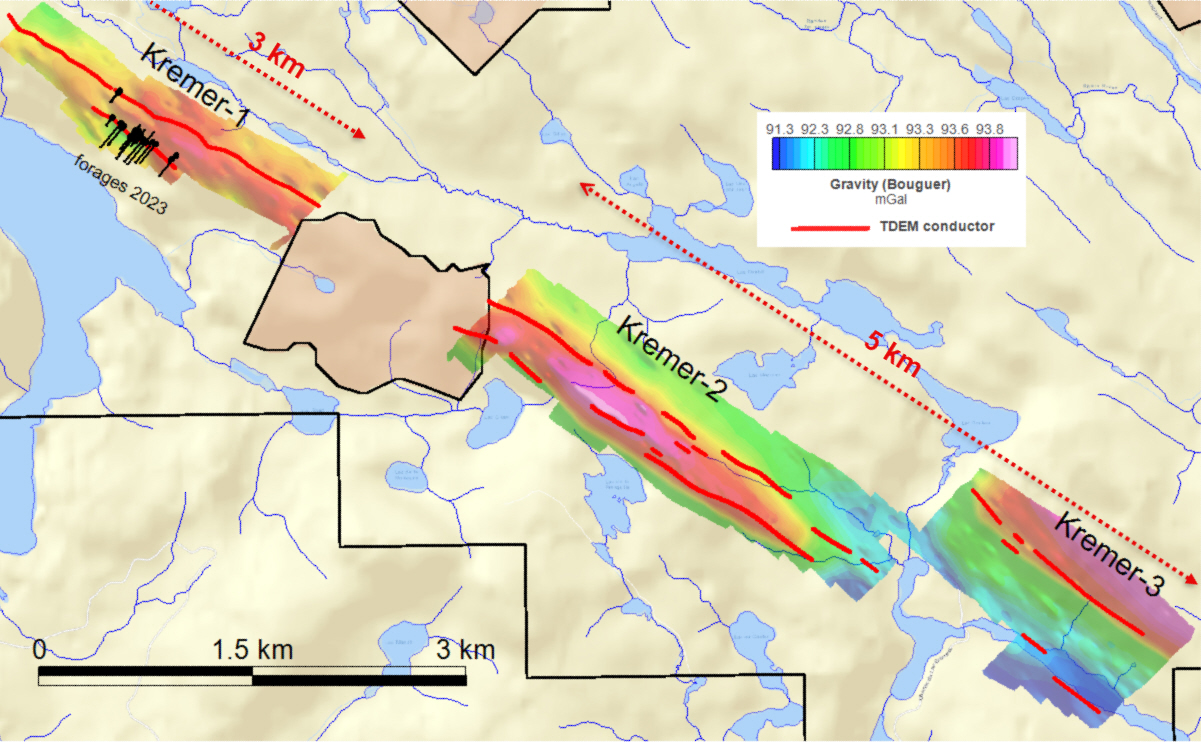
Exploration work has identified three principal areas of interest along the broader northwest-southeast prospective corridor:
- Kremer-1: the drilled area where Ni-Cu-Co-bearing sulfides were first confirmed. Surface prospecting and trenching identified sulfides at several locations over approximately 700 metres.
- Kremer-2: the current priority exploration target, where surface sampling has confirmed Ni-Cu-Co-bearing sulfides at multiple locations and drilling is now underway.
- Kremer-3: a separate, less advanced follow-up exploration area located farther southeast that remains undrilled.
Kremer-2: The Highest-Priority Target — Now Being Drill-Tested
Kremer-2 is located southeast of Kremer-1 along the broader northwest-southeast-trending prospective corridor.
It is Ni-Co Energy’s highest-priority exploration target because several independent lines of evidence converge on the same area:
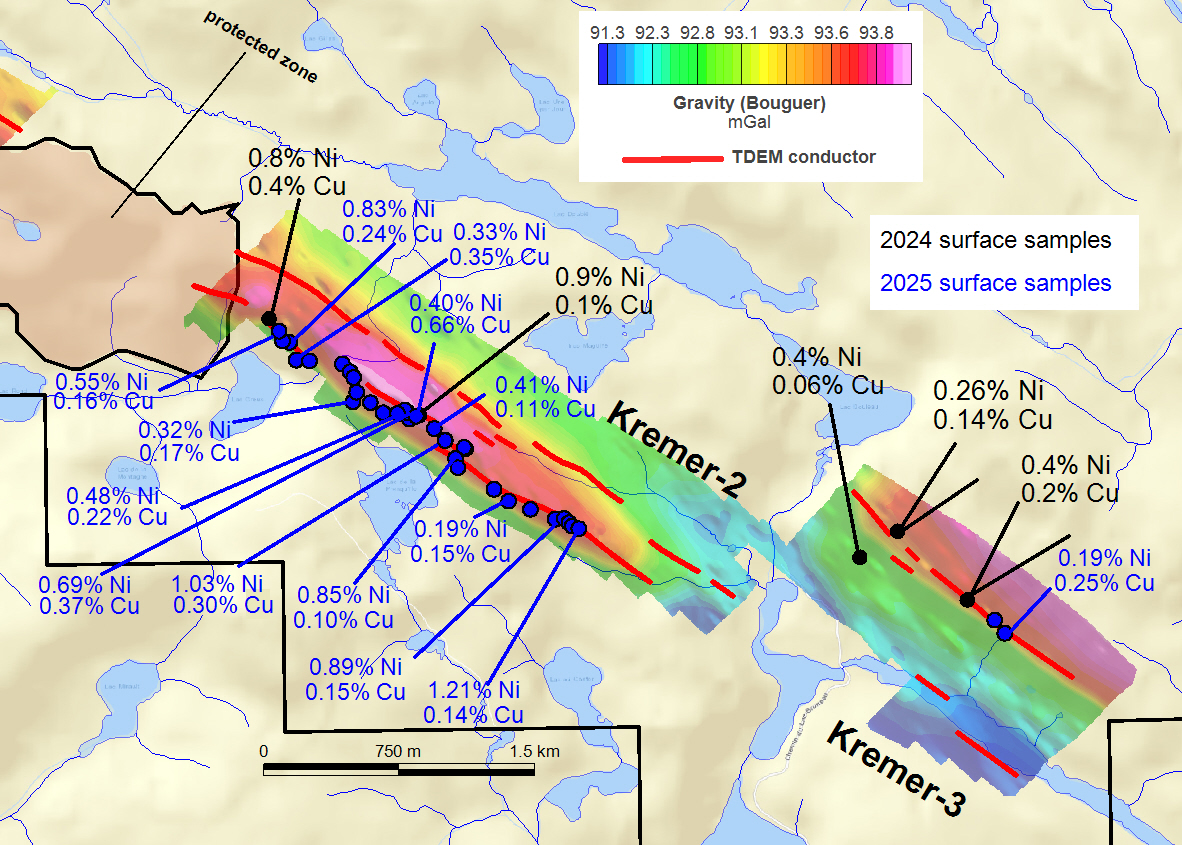
- nickel-, copper- and cobalt-bearing sulfides confirmed by laboratory assays at surface;
- a more extensive and complex TDEM conductor distribution than at the drilled Kremer-1 area;
- associated magnetic and gravity responses; and
- a geological setting considered favourable for sulfide mineralization.
Drilling began at Kremer-2 on September 8, 2026, marking the first subsurface test of the target. The current program is designed to determine whether the surface mineralization and geophysical responses are associated with mineralized zones having meaningful true widths, grades and continuity at depth.
Geophysical anomalies are exploration targets and do not establish mineralization, grade, thickness, continuity or economic potential.
Certified Surface Assays
On July 22, 2026, Ni-Co Energy announced certified assay results from 36 selected surface samples collected in October 2025 from Kremer-2 and Kremer-3.
Thirty-three of the samples came from Kremer-2.
Eleven of those 33 samples returned more than 0.5% Ni. Highlighted results include:
- 1.21% Ni, 0.14% Cu and 0.10% Co
- 1.03% Ni, 0.30% Cu and 0.18% Co
- 0.89% Ni, 0.15% Cu and 0.10% Co
- 0.69% Ni, 0.37% Cu and 0.23% Co
The Kremer-2 samples were collected at multiple sites, most located within an approximately 2 km portion of the broader Kremer-2 geophysical corridor. The assay results confirm Ni-Cu-Co-bearing sulfide mineralization at multiple surface locations.
The samples are selective by nature and do not establish grade continuity, true width or continuity of mineralization between the individual sample sites.
Read the July 22, 2026 news release and view the complete assay table →
Why Kremer-2 Matters
Kremer-1 established that Ni-Cu-Co-bearing sulfides are present within the Kremer system.
Kremer-2 represents the project’s principal current test of scale because it combines:
- assay-confirmed Ni-Cu-Co-bearing sulfide mineralization at multiple surface locations;
- a more extensive and complex TDEM conductor distribution than at Kremer-1;
- associated magnetic and gravity responses; and
- a geological setting considered favourable for sulfide mineralization.
The current drilling program is designed to determine:
- the geological source of the conductors;
- whether Ni-Cu-Co-bearing sulfides continue below surface;
- true widths;
- grades;
- lateral and depth continuity; and
- whether the mineralization forms larger accumulations.
Kremer-2 is a priority exploration target currently being tested by drilling. It is not a deposit, and no mineral resource has been defined.
2026 Drill Program — Underway
Drilling began at Kremer-2 on September 8, 2026, as part of Ni-Co Energy’s approximately 7,500-metre 2026 drill program. The program is focused primarily on Kremer-2, with follow-up drilling also planned at Kremer-1.
At Kremer-2, drill holes are designed to intersect the interpreted southwest-dipping target geometry at a high angle and provide the first subsurface test of the surface mineralization and associated geophysical responses.
At Kremer-1, follow-up drilling is intended to better constrain the true width, geometry and continuity of the mineralized zones intersected in 2023, where most holes were drilled predominantly subparallel to the interpreted mineralized geometry.
Borehole electromagnetic surveys are planned on the majority of drill holes to:
- characterize intersected conductive zones;
- determine their orientation and extent;
- identify possible conductors located near, but not intersected by, drill holes; and
- guide follow-up drilling.
Drilling, borehole EM and surface geophysical results will be integrated into an updated three-dimensional geological and geophysical interpretation.
The current drill program will test only part of the approximately 8 km prospective geological and geophysical corridor. Several conductors, extensions and exploration areas, including Kremer-3, are expected to remain for follow-up evaluation after the current program.
Kremer-3
Kremer-3 is a separate, undrilled follow-up exploration area located farther southeast along the broader prospective corridor. It is currently less advanced than Kremer-2.
Three selected surface samples were collected at Kremer-3 in 2025. Additional prospecting, geological mapping and geophysical work will be required to further evaluate the area and determine whether specific drill targets can be defined.
Kremer-2 and Kremer-3 should currently be considered distinct exploration areas. Mineralized continuity between them has not been demonstrated.
Project Status
Exploration is ongoing. No mineral resource, mineral reserve or economic study has been established for the Kremer Project.
Selected surface samples are selective by nature and are not necessarily representative of mineralization across the property.
Geophysical anomalies represent exploration targets only. They may be caused by sulfides, but also by graphite-bearing or sulfide-bearing metasedimentary rocks, oxide minerals or other geological units.
There is no assurance that ongoing or future exploration work will result in the discovery of an economic mineral deposit.
The scientific and technical information contained on this page has been reviewed and approved by Marc Boivin, P.Geo., Vice President, Exploration and a director of Ni-Co Energy Inc., and a “Qualified Person” as defined by National Instrument 43-101 – Standards of Disclosure for Mineral Projects. Mr. Boivin is not independent of the Company.
Explore the Project
View the corporate presentation ↗.
View the factsheet for investors ↗.